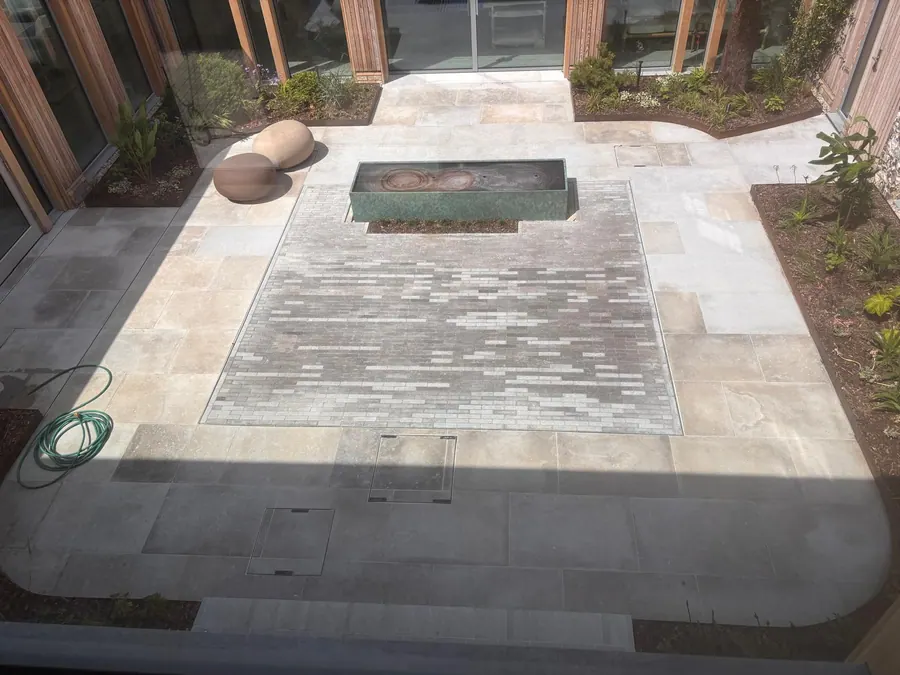
Advice · Patios & Paving
How to Lay a Patio (and When to Get It Done for You)
A patio is one of the most satisfying garden jobs to get right, and one of the easiest to get wrong, because almost all of it is decided below the slabs rather than on top of them. This is how we lay a patio that stays flat, drains properly and still looks right years later, written from laying them for a living across Hampshire rather than from a brochure.
Written by Jamie Rogerson · 25+ years on the tools · Updated 28 October 2026
You can lay a patio yourself if you are fit, patient and ready for the digging, which is the hard part. The steps below work either way, and we will be honest further down about where it is worth getting a team in. Every photo linked from this guide is our own work.
What actually makes a patio last?
The base, and the fall. A patio fails from underneath, not from the top: if the ground below moves or holds water, the best slabs in the world will rock, lift and crack. Get a properly dug-out, compacted sub-base and a slight slope to shed water, and almost everything else is detail.
It is the same lesson as every other outdoor surface we build. The part you cannot see once the job is done, the groundwork, is the part that decides whether it is still flat in ten years. Spend your effort and your budget there first.
What do you need to lay a patio?
The materials are simple: a hardcore or MOT Type 1 sub-base, a bed of mortar or a sand-and-cement mix to lay on, the slabs themselves, and a mortar or pointing compound for the joints. The tools are a spade, a wheelbarrow, a wacker plate (a plate compactor you can hire), a rubber mallet, a spirit level and a string line.
The two things people underestimate are the amount of spoil that comes out of the ground, which has to go somewhere, and the compactor. Skipping the compactor to save a hire fee is the single most common reason a patio sinks later. Choosing the slab is the easy and enjoyable part, and it matters least to whether the patio lasts.
How do you lay a patio, step by step?
In order: mark it out, dig down far enough for the base plus the slab, lay and compact the sub-base, set your fall, lay each slab on a full mortar bed, then point the joints once it has set. Working in that sequence is what keeps it flat and draining.
| Step | What you do |
|---|---|
| 1. Mark out and dig | Set the shape with pegs and string, then dig out deep enough for the sub-base, the mortar bed and the slab. Most patios need more digging than people expect. |
| 2. Lay the sub-base | Fill with hardcore or MOT Type 1, rake it level, and compact it in layers with a wacker plate until it is solid underfoot. |
| 3. Set the fall | Build in a slight slope away from the house so water runs off, not back towards the wall. More on the fall below. |
| 4. Lay the slabs | Lay each slab on a full bed of mortar, not on five dabs, tapping it level with a rubber mallet and checking with a level and string line as you go. |
| 5. Point the joints | Once the slabs have set, fill the joints with mortar or a pointing compound so water cannot get underneath and nothing shifts. |
How much fall does a patio need to drain?
A gentle one, running away from the house. The standard is roughly a one-in-eighty slope, about a centimetre of drop for every eighty centimetres of patio, which is enough to shed rainwater without being noticeable when you stand on it.
The direction matters as much as the amount: water should always run away from the building, towards a lawn, a border or a drainage channel, never back towards the wall where it can sit against the house. On a patio right next to the house this is the detail we are most careful about.
What are the most common patio mistakes?
Four come up again and again: too shallow a dig, skipping the compactor, laying slabs on dabs instead of a full bed, and no fall or the fall running the wrong way. Every one of them shows up a season or two later as a rocking slab, a puddle or a crack.
The theme is always the same: the mistakes are in the groundwork and the prep, not in the laying. A patio that was dug deep, compacted properly and given the right fall will forgive a lot. One that was rushed underneath will not, however neat the slabs look on day one.
Can I lay a patio myself, or should I get it done?
A small, flat, square patio on firm ground is a realistic weekend job for a fit, patient DIYer with a hired compactor. It is worth getting a team in when the ground slopes, when there is a lot of spoil to dig out and cart away, when access is tight, or when the patio needs to tie into steps, levels or a wall.
The honest line is that the laying is learnable but the groundwork is the heavy, get-it-wrong-once part, and it is where most DIY patios fail. If you would rather not gamble on the bit you cannot see, that is exactly the part we take on. You can see our patios and paving work, or send us photos for a fixed price.
Thinking about a new patio, or sorting out one that never drained right? Send us a few photos and the rough size, call 07813 073814 or use the quote form, and we will give you a fixed price. There is more of our patio work to see first.
Get In Touch
Let's Talk About Your Project
Send us a message or give us a call. We cover Waterlooville, Portsmouth & surrounding areas.