Advice · Planning & Permissions
Do I Need Planning Permission for My Garden?
Most garden work does not need planning permission, but some does, and the rules tighten in conservation areas and inside the South Downs National Park. This is a plain-English guide to the jobs people ask us about most. Treat it as a starting point, not a planning decision: always check with your own council before you order materials, because one street can be treated differently from the next.
Written by Jamie Rogerson · 25+ years on the tools · Updated 28 October 2026
We work across several planning authorities (Havant, Fareham, Winchester, East Hampshire and Portsmouth City councils, plus the South Downs National Park Authority), so we flag anything on your job that might need permission when we quote, and point you at the right page. The council and conservation-area detail for each town is on our area pages.
In short, what needs permission?
Most garden jobs need no permission. The main exceptions are a water-shedding driveway over five square metres draining to the road, a fence or wall over one metre high by a road (two metres elsewhere), raised decking over 30cm, and almost anything inside a conservation area or the South Downs National Park. The detail, and the exceptions, are in the sections below.
| Garden job | When you usually need permission |
|---|---|
| New driveway | Only if you lay more than 5 square metres of hard, water-shedding surface that drains onto the road. Permeable surfaces are fine at any size. |
| Fence, wall or gate | Over 1 metre high next to a road used by vehicles, or over 2 metres high anywhere else. |
| Patio or paving at ground level | Normally never in a back garden. In a front garden the driveway rule applies. |
| Decking | If it sits more than 30cm above the ground, covers more than half the garden, or is forward of the front of the house. |
| Retaining wall | Same as any wall: over 1 metre next to a road, or over 2 metres elsewhere. |
| Anything in a conservation area or the National Park | Often tighter, and sometimes needed where it normally would not be. Check first. |
Do I need planning permission for a new driveway?
Usually not. You can lay a driveway of any size without planning permission if it uses a permeable or porous surface that lets water drain through, such as gravel, permeable block paving or porous asphalt, or if the rainwater runs off to a lawn or border instead of the road (Planning Portal). Permission is only needed if you cover more than five square metres with a traditional, water-shedding surface that drains onto the road.
The dropped kerb is a separate matter. If you need to cross the pavement to reach the drive, that needs a dropped kerb, which is applied for from the highway authority (Hampshire County Council across most of our area, and Portsmouth City Council inside the city), and it is illegal to drive over a kerb without one. We build our driveways to drain properly as standard, which is why most of them need no planning permission at all.
Do I need planning permission for a fence or garden wall?
You can put up, alter or take down a fence, wall or gate without permission as long as it is no more than one metre high next to a road used by vehicles, or no more than two metres high anywhere else, measured from ground level (Planning Portal). Go above those heights and you need permission.
There are a few catches. It is different if your home is a listed building or sits next to one, and different again if permitted development rights have been removed by an Article 4 direction or a planning condition, which is common in conservation areas. In a conservation area you can even need permission to take an existing wall or fence down. When we quote a new fence we build to the right height for the boundary and flag it if your street is one of the stricter ones.
Do I need permission for a patio or decking?
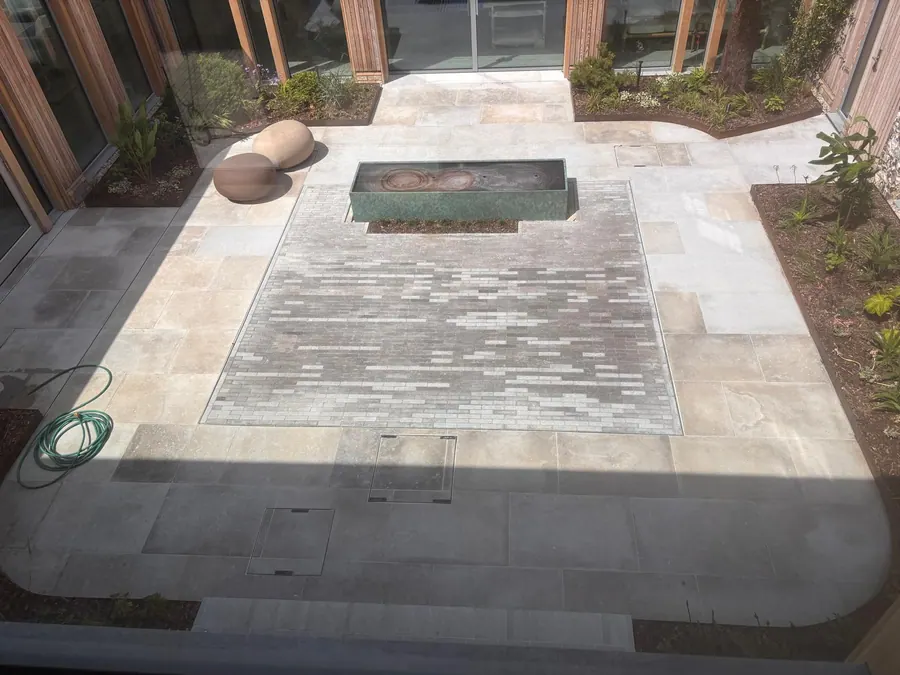
A patio or paving laid at ground level in a back garden does not normally need planning permission. In a front garden it follows the driveway rule above: a permeable surface is fine at any size, and a water-shedding one over five square metres needs permission.
Decking is allowed without permission if it sits no more than 30cm above the ground, covers no more than half the garden once you count any other buildings, and is not forward of the front of the house (Planning Portal). Raised decking above that can need permission, and the limits are tighter inside the South Downs National Park and on a listed building, where decking may not be allowed at all.
Do I need planning permission for a retaining wall?
A retaining wall counts as a wall for planning, so the same limits apply: one metre next to a road, two metres elsewhere, measured from ground level. A lot of garden retaining walls sit under those heights.
Separately from planning, a wall that holds back a real bank of earth is a structural job, and a larger or load-bearing one can bring building regulations into play as well. That side is about the wall being built strongly enough to hold the ground safely, not about whether it is allowed. We build retaining walls to hold the ground properly, and we will tell you honestly when a job is big enough that it is worth checking both with the council.
What is different in a conservation area or the South Downs National Park?
Conservation areas and Article 4 directions can take away the permitted-development rights above, so work that is normally allowed can need permission first. Our patch has a lot of them. Havant borough alone has fourteen conservation areas, among them Emsworth, Langstone and Old Bedhampton, and Langstone carries an extra Article 4 direction. Portchester's Castle Street has had an Article 4 direction since 2015, and parts of Southsea need permission to put a hard standing in a front garden or to alter a front boundary wall (Havant Borough Council, Fareham Borough Council, Portsmouth City Council).
The South Downs National Park is its own planning authority, with tighter rules, and its boundary runs close to Horndean, Clanfield and Denmead. If your job sits on that side of the line, it is worth checking before anything is ordered. Each of our area pages names the council and the conservation areas for that town.
Planning permission or building regulations: what is the difference?
They are two separate systems. Planning permission is about whether you are allowed to build the thing where you want it. Building regulations are about whether it is built safely. A job can need one, both or neither: a standard patio usually needs neither, while a big structural retaining wall can need both.
We do not submit planning applications for you, but we will tell you when a job is likely to need one and point you at the right council's page, so you are not left guessing.
The short version: most garden jobs do not need planning permission, but a few do, and in our area the rules can change street by street. Send us photos and tell us what you are planning, call 07813 073814 or use the quote form, and we will flag anything that needs checking before we start. The council details for your town are on our area pages.
Get In Touch
Let's Talk About Your Project
Send us a message or give us a call. We cover Waterlooville, Portsmouth & surrounding areas.